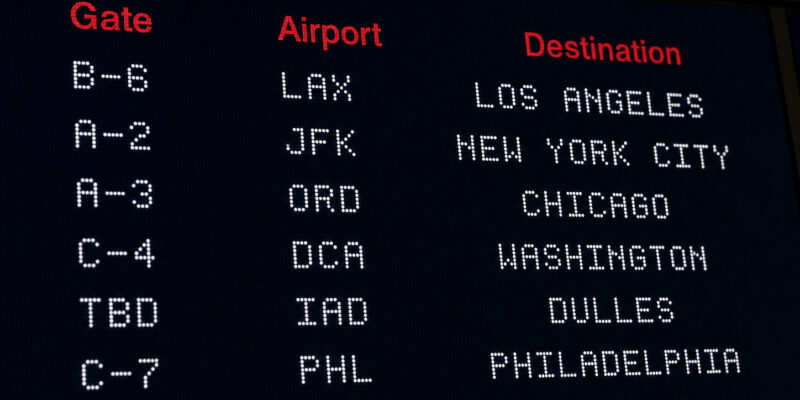
When people refer to an airport by three letters, they are usually talking about its IATA airport code. These codes appear on airline tickets, baggage tags, boarding passes, flight search websites, airport screens, and travel itineraries.
They are short, memorable identifiers that help travelers, airlines, and booking systems refer to airports quickly and consistently.
What does IATA mean?
IATA stands for the International Air Transport Association. It is the organization responsible for assigning many of the three-letter airport codes used in commercial air travel.
For example:
Airport
IATA code
London Heathrow
LHR
New York John F. Kennedy
JFK
Los Angeles International
LAX
Dubai International
DXB
Paris Charles de Gaulle
CDG
So when someone says, “I’m flying from LHR to JFK,” they mean they are flying from London Heathrow Airport to John F. Kennedy International Airport in New York.
Why do airports have three-letter codes?
Airport names can be long, similar, or difficult to translate across languages. Three-letter codes make things simpler.
They help with:
Booking flights
Printing boarding passes
Sorting luggage
Displaying flight information
Identifying airports in airline systems
Instead of writing “Hartsfield-Jackson Atlanta International Airport” every time, airlines can use ATL. It is faster, clearer, and easier to fit on screens and tags.
How are airport codes chosen?
Some codes are easy to understand because they come directly from the airport or city name.
For example:
LHR = London Heathrow
JFK = John F. Kennedy
ATL = Atlanta
SIN = Singapore
AMS = Amsterdam
Others are less obvious because of older city names, local language, historical reasons, or because the most obvious code was already taken.
For example:
ORD = Chicago O’Hare, originally connected to the area’s old name, Orchard Field
DXB = Dubai, using an X because “DUB” was already assigned to Dublin
PEK = Beijing, based on the older English spelling “Peking”
That is why some airport codes feel logical, while others seem random at first glance.
Are airport codes the same as city codes?
Not always.
Some cities have more than one airport. In those cases, each airport has its own IATA code.
For example, London has several airport codes:
Airport
Code
Heathrow
LHR
Gatwick
LGW
Stansted
STN
Luton
LTN
London City
LCY
A city may also have a broader city code used in some booking systems. For example, LON can refer generally to London-area airports, while LHR refers specifically to Heathrow.
What about four-letter airport codes?
You may also see four-letter airport codes. These are usually ICAO codes, used more often in aviation operations, air traffic control, and flight planning.
For example:
Airport
IATA code
ICAO code
London Heathrow
LHR
EGLL
New York JFK
JFK
KJFK
Los Angeles
LAX
KLAX
Paris Charles de Gaulle
CDG
LFPG
For most travelers, the three-letter IATA code is the one they will see most often.
Why airport codes matter to travelers
Knowing airport codes can help you avoid mistakes when booking flights. This is especially useful in cities with multiple airports.
For example, flying into LHR is very different from flying into STN or LGW, even though all are associated with London. The airport you choose can affect travel time, transport costs, and convenience.
Airport codes are also useful when checking luggage tags. If your bag tag says JFK, your luggage is headed to New York JFK. If it says LGA, it is going to LaGuardia instead.
Final thoughts
Three-letter airport codes are called IATA airport codes. They are a simple but important part of modern air travel, helping airlines, passengers, airports, and baggage systems communicate clearly.
The next time you see codes like LHR, JFK, LAX, or DXB, you will know they are not random letters. They are standardized airport identifiers that keep the world of travel moving smoothly.